

Written by Eufrasia Claudia Gengkor, Anna Asri Nangkur, Modesta Wawang, and Aprianus Delon
MANGGARAI, PENA1NTT.COM – Never in human history have people been able to communicate as easily as they do today. A message can cross continents in seconds, news travels instantly, and millions of conversations take place every moment.
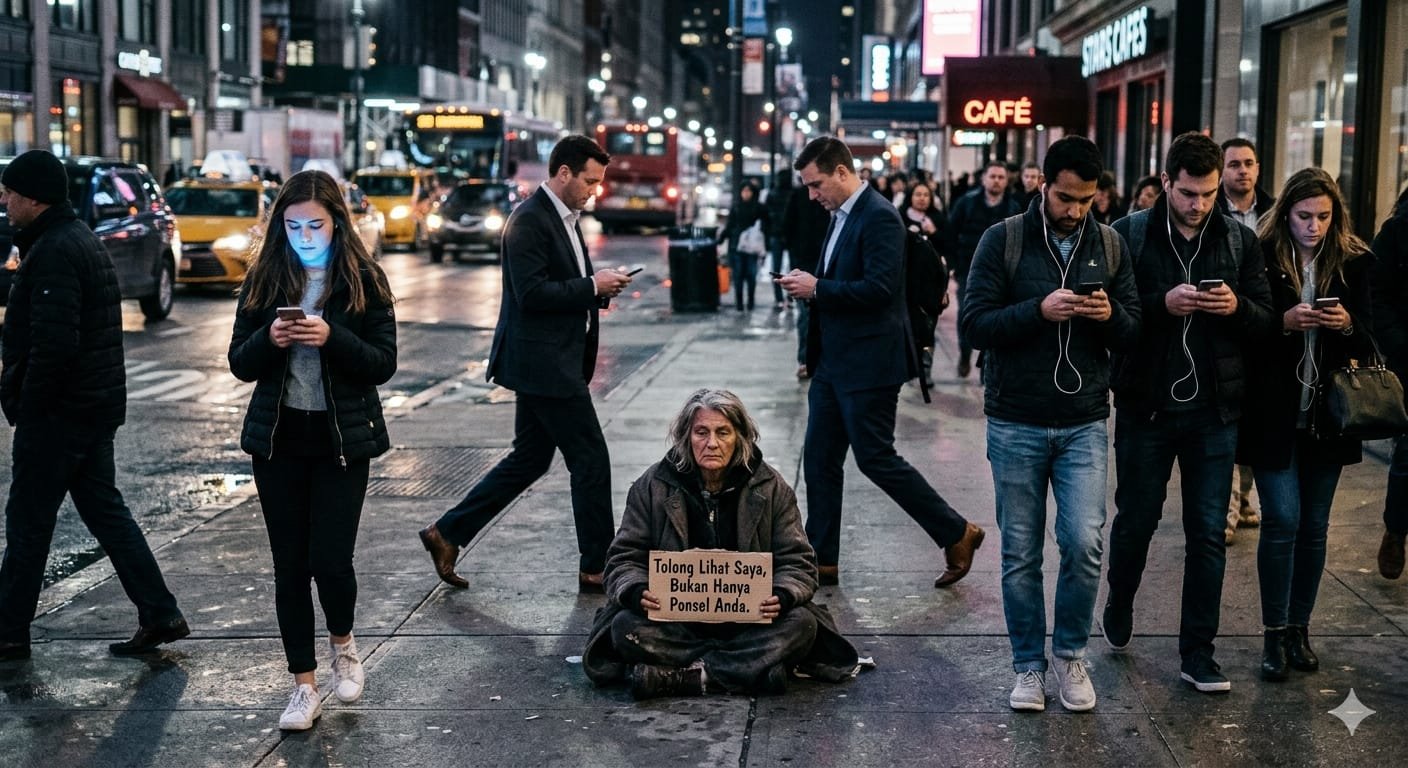
Yet despite this unprecedented level of connectivity, many people feel increasingly isolated, misunderstood, and emotionally distant from one another.
This contradiction raises a troubling question: if communication has become easier than ever, why does genuine understanding seem harder to achieve?
The answer may lie in a growing empathy crisis. Empathy, the ability to understand and share the feelings of others, has always been essential for healthy relationships and stable communities. It allows people to cooperate, resolve disagreements, and support one another during difficult times.
However, modern life often encourages speed, efficiency, and instant reactions rather than careful listening and understanding. As a result, empathy may be gradually losing its place in everyday interactions.
This trend can be seen in the way people communicate. Many conversations today happen in fast-paced environments where immediate responses are expected. People are often encouraged to express opinions quickly rather than consider different perspectives.
Consequently, communication can become more focused on being heard than on understanding others. The problem is not technology itself but the habits that have developed around it. When reflection is replaced by reaction, empathy inevitably suffers.
Beyond communication, changes in social behavior also reveal a deeper issue. Across many societies, loneliness and social isolation have become increasingly common concerns.
Health experts have warned that a lack of meaningful social connection can negatively affect both physical and mental well-being.
At the same time, simple activities that once brought people together, such as sharing meals, spending time with neighbors, or participating in community events, are becoming less common in many parts of the world.
These changes suggest that while people may be connected digitally, they are not always connected socially.
The issue is not limited to one country or culture. From North America to Europe and parts of Asia, researchers and policymakers have expressed concern about rising levels of loneliness and weakening social bonds.
Different societies may experience the problem in different ways, but the underlying pattern is remarkably similar: people have more opportunities to communicate than ever before, yet many struggle to build meaningful relationships. This makes the empathy crisis a global challenge rather than a local one.
Some evidence even suggests that empathy itself may be declining. Studies conducted over the past two decades have found lower levels of empathy among certain groups of young adults compared to previous generations.
While the reasons remain debated, the findings have sparked important discussions about the social and cultural factors shaping human relationships. Nevertheless, it would be unfair to conclude that empathy is disappearing entirely.
In fact, there are reasons for optimism. Public awareness of issues such as mental health, discrimination, and social inequality has grown significantly in recent years. People are often more willing to discuss these issues openly than in the past.
However, awareness should not be confused with empathy. Knowing that a problem exists is only the first step; truly understanding the experiences of others requires patience, humility, and genuine engagement.
If empathy continues to weaken, the consequences could extend far beyond individual relationships. Communities may become more divided, public discussions more polarized, and social trust more difficult to maintain.
A society that struggles to understand different perspectives may also struggle to solve collective problems. For this reason, empathy should not be viewed merely as a personal virtue but as a social necessity.
Addressing the empathy crisis requires conscious effort. Schools should encourage students to engage with diverse perspectives and develop strong listening skills. Families should create environments where meaningful conversations are valued.
Individuals, meanwhile, must resist the temptation to judge quickly and instead make a deliberate effort to understand others. Empathy is not a passive trait; it is a skill that must be practiced regularly.
Ultimately, the empathy crisis is not simply about people caring less. It is about a world that increasingly rewards speed while neglecting understanding.
Humanity has succeeded in building technologies that connect billions of people across the globe, yet the true challenge of the twenty-first century may be learning how to connect on a deeper human level.
If societies fail to preserve empathy, they risk losing one of the very qualities that makes cooperation, trust, and community possible. In a world overflowing with communication, genuine understanding may become the most valuable connection of all.