

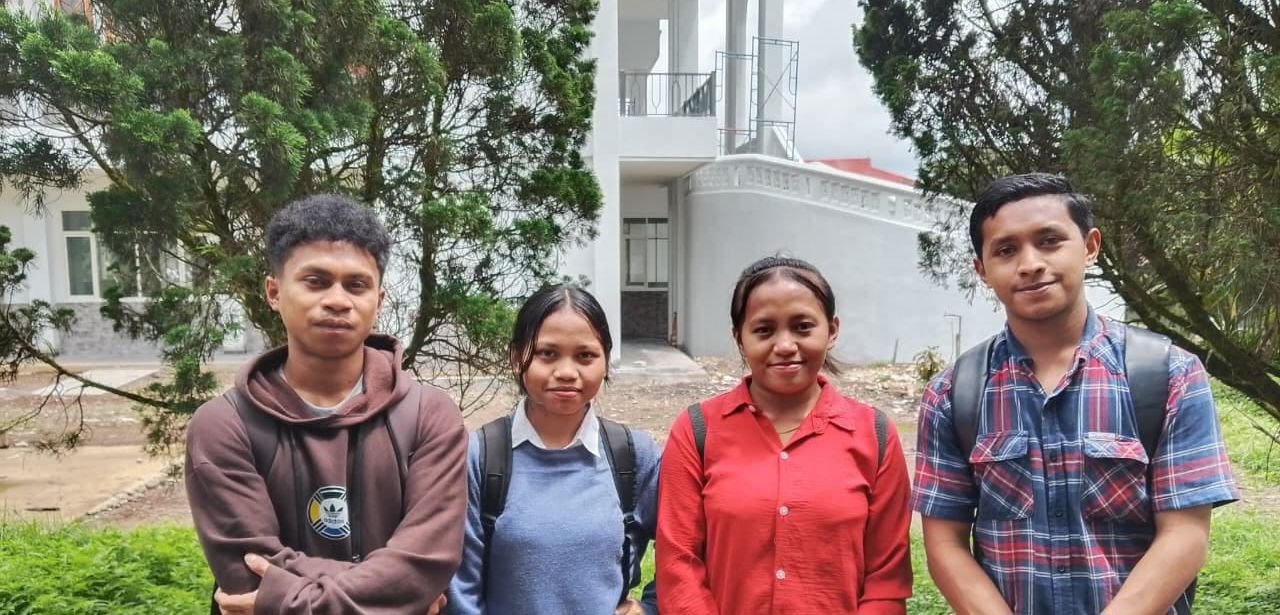
Opiny by: Edilburga Yasinta Murni, David Aldiano Dama, Hendrikus Gebren, and Yasinta Ndeweng
MANGGARAI, PENA1NTT.COM – Today, technological advancements have completely transformed the way we live. We no longer simply use technology; we live within it.
Innovations such as smartphones, artificial intelligence (AI), and humanoid robotics have brought about extraordinary efficiency across various sectors.
However, behind the glitter of its positive impacts lie hidden negative consequences that pose a threat. Ironically, this threat does not stem from the technology itself, but rather from users’ exploitative behavior for personal gain.
One of the technology platforms most prone to abuse is social media. Today, social media has become a breeding ground for the spread of disinformation and fake news.
This phenomenon is no longer merely a common information disruption, but a real threat capable of undermining the stability of society’s social order.
In 2017, the Ministry of Communication and Information Technology (now the Ministry of Digital Economy and Information Technology) recorded approximately 800,000 instances of fake news circulating online.
A survey conducted by the Indonesian Telematics Society (Mastel) that same year revealed that the majority of the public encountered more than one piece of fake news every day.
The spread of misinformation in the digital realm often serves as the primary catalyst for strained interpersonal relationships stemming from a crisis of trust.
Many people find themselves caught in an information vortex without verifying the original sources. As a result, misguided decisions are made that fuel collective suspicion and a culture of mutual blame.
If left unchecked, this phenomenon will become a ticking time bomb. Society will fragment into small, insular groups (extreme factions) that shut themselves off from one another.
The consequences are serious: physical unrest and deadly conflicts could erupt simply because of a single false narrative that is widely believed.
On the other hand, certain individuals also use this disinformation as a tool to sway public opinion. Disinformation is exploited for various purposes, ranging from economic and political interests to gaining popularity.
By capitalizing on the public’s tendency to quickly believe such false information—such as feelings of anger, fear, or sympathy—this demonstrates that in today’s increasingly sophisticated digital age, factual information often loses out to false information.
Therefore, there is a need for collective awareness to build a strong culture of digital literacy. This is so that the public does not merely become consumers of information, but transforms into smart and responsible users.
Being critical of the content of information, verifying sources, comparing it with other references, and refraining from immediately sharing information whose accuracy is unclear are all concrete ways to help combat disinformation.
In conclusion, disinformation is a real threat in the digital age that not only undermines the quality of information but also erodes logic, trust, and social cohesion.
Technological advancements, which should serve as tools for progress, can instead become “digital poison” when misused by irresponsible individuals. The consequences are far-reaching, ranging from flawed decision-making to the potential for serious social conflict.
Therefore, the key to addressing this phenomenon lies in collective awareness and responsibility.
The public needs to equip itself with digital literacy and critical thinking skills so as not to be easily swept up in a flood of misleading information.
At the same time, support from educational institutions and the government is also essential to creating a healthy and trustworthy digital ecosystem.